
Digging up old controveries...
She comes not to bury Hernán Cortés (again)... but to honor him.

I must have had some sort of bi-polar episode when I started putting this together. If “deep thoughts” roaming around my caffeinated head when you tend to try making sense of how we think about thinking is your thing, go right ahead and read through the whole post. If you’d rather just skip to the absurdity of the whole “Cortés — hero or villian” thing, skip to the bold-faced section.
I’m the first to admit that History (with a capital “H”) is malleable. My own small contribution to Mexican history (Gods, Guchupines and Gringos) was never meant as more than a over-view of the mainstream Mexican point of view of their own history (The outline for my book was taken nearly straight for the 2000 edition of the standard 6th grade history textbook’s table of contents) although I tried to emphasize the multi-culturalism — beyond the simplistic (gringo) assumption of a simply indigenous/Iberian mix.
This isn’t a confession, just a recognition that — if I were to re-write it — it would it would be a different book. And not just the last few chapters, where (unwisely) I made assumptions based on the conditions of the time what would be the expected results (I never saw the disastrous escalation of the“drug war”, let alone the re-interpretation of the 300 year colonial period and its lingering influence.
Nor, in some respect, of the “Conquest”. No where is that more evident than in the recent re-interpretation of “La Malache”… Malinalli, the “Aztec Princess slave/mistress/interpreter for Hernán Cortés. The previous standard POV — that she was out for revenge against the Aztec elites and happy to bring down the Empire (itself a problematic term for a non-European government) focused perhaps too much on her presumed fall from the old elites, whereas, while there is no single accepted version of her story, feminists and others focus their attention on Malinalli as a victim… a sex-slave, and as an intelligent woman with linguistic gifts that gave her some agency to leverage better conditions for herself… and, some argue… for the conquered people: a victim who refused to be victimized.
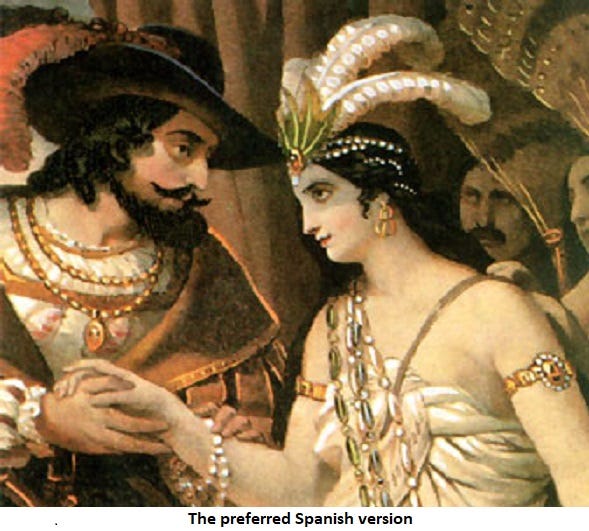
While such re-interpretations are easily construed as “politically motivated” when you come right down to it, History with a capital “H” has always been politicized — “the winners write the histories”, and all that. On the other hand, there have always been those historians who specialize in the not-winners histories. And, those who write the “history from below”. . . who try to make sense of the cultures of the past — and those of the present — from the ordinary lives and experiences of the non-elites, the people who either couldn’t record their experiences, or whose experiences (like that of Malanalli) have only been interpreted through their interactions with elites.
When it comes to the Cortés-Malanalli story, we face both problems with what was the standard story. Three problems really.
Standard histories — especially those in English — have presented Spain as an anomaly among European empires. As Napoleon put it, “Africa begins at the Pyrenees” although outside events (notably the Reformation1. Given (North European/Protestant) biases, the Spanish were portrayed as particularly cruel and fanatical among imperials in the Americas. This was somewhat ameliorated by a generation of Spanish reactionary historians in the late 19th and early 20th centuries — after the collapse of the Spanish empire — with “Black Legend” studies, that attempted to revise the view, seeing Spain as a “positive” force in its imperial visions. At least, unlike historian of the post colonial English and Dutch possessions in the Americans, the “Black Legenders” did not simply ignore the indigenous communities, nor completely dismiss them as “savages” to be exterminated. Rather, they sought to claim the Spanish had “reformed” those societies, and “blessed” them with an “advanced” way of life and the “true religion”.
The early 20th century thru another loop… coming out partially through the “scientific racism” of the time, the downside of European Positivism (enthusiastically embraced by the elites in Latin America) there was a new political theory taking hold: Fascism, with its assumptions in the various Fascist of the innate superiority of their own culture, or “race”. Within multi-cultural Spain, this would mean quashing some ethnicities (like the Basques and Catalans) and settling for a presumed supremacy based on having led a “civilizing movement” in the world — “saving Europe from African Muslims, and “creating” a Hispanic world in the Americas, within what we call “Latin America”, with not just multi-cultural, but multi-”racial” histories, it meant redefining the terms.
José Vasconcelos, for all his contributions to Mexico and the Americas in general, was a Fascist. As much as it served to “uplift” the perception of the peoples of Latin America it was based on reformulating the concept of a “master race” as the “Raza Cosmica”… the “cosmic race”… the best of the best, from the mix of indigenous and European (with a smidgen of African and Asian) traits.
And… so for now, there are two (at least) ways to read figures like Cortés and Mallanali. While obviously, not everyone who takes pride in a Conquistador ancestor, is a racist or Fascist, nor those who deplore the Conquest are simply revising the history to fit a leftist political narrative, the nuances get lost.
Cortés’ Conquest of Mexico is one of the pivotal events in human history, no doubt. And no doubt Cortés himself was a political and military genius in his own way. And no doubt, he was a total asshole.
In their defense of Hernán Cortés, the right wing forgets that even by the standards of his time, he wasn't a defensible figure. Just ask Charles V (or Charles I). Besides everything else, Cortés murdered his wife, Catalina Suárez Marcayda, with his own hands in their home in Mexico. He strangled her; women testified to seeing the marks on Catalina's neck. He was tried for her murder. Even by the standards and within the context of the time, it was indefensible.
—Elena Gil (Mixe writer, linguist, translator and linguistic rights activist)
…. not to mention he may or may not have been responsible for the sudden demise of the judge sent from Spain to hear the case with a few days of his arrival, nor things perhaps seen as acceptable at the time, like his tolerance for (and more likely than not encouragement and participation in) the slaughter of Cholula.
To which, of course, the response is, “Well, yeah.. the Aztecs were a pretty bloodthirsty bunch too”. Which is true, though not on the scale often attributed to them… and something that would take another few hundred thousand words to adequately address.
At any rate, the defeat of the Aztecs at the Battle of Tlateloco (13 August 1521) “… was not a triumph, nor was it a defeat. It was the painful birth of the mestizo nation that is the Mexico of today,” in the words of a memorial at the site of Cuauhtémoc’s surrender.
In other words, an event… a “world shaking event”… that changed not just Spain and Mexico but the entire planet… and hardly due to any single person. Yet…
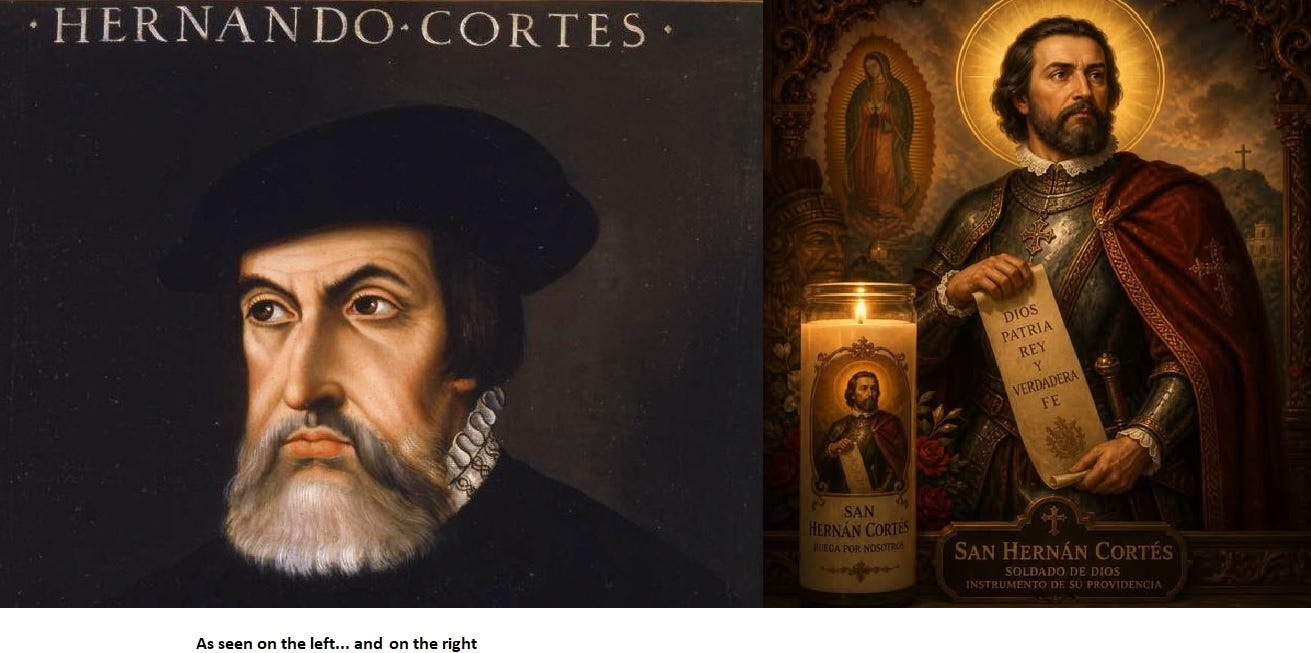
It’s tempting to simplify History to individuals, and while the “Great Man” theory of History is more than a little dated, we still want to simplify the complexity of events like this, focusing on an individual as at least the symbol of the event… in this case… making Spain Great (for a few hundred years, at least). And, moreover, once we have the symbol — Cortés — a brilliant military tactician and skilled negotiator — any flaws must be explained away. That such people were people… and products of their time.. is forgotten.
Cortés wasn’t that unusual in being a total sexist pig, maybe even by the standards of the early 16th century elites. Murdering his wife (though never definitively proven) was outre even in his own time, although taking advantage of a subordinate woman was something might have been tolerated, but certainly beyond the pale today — making the President of Madrid, Isabel Díaz Ayuso’s homage to the reinterpretation of the Cortés-Mallanali story more than a academic dispute over historicity.
Diaz Ayuso is a polemical figure herself… a leader of the “righter” wing of the right wing Spanish Patrio Popular — apologists for the Franco regime, somewhat similar to the more extreme members of the MAGA movement within the conservative Republican Party in the US. It isn’t so much that she has accepted one or another version of that early 16th century relationship as true, as it is, she is using taxpayer funding to push the narrative, not for its own sake, but to justify her (and her wing of her party’s) geopolitical interests.
Reportedly, Ayuso has spent 300,000 € to finance not just her own visit to Mexico (ostensibly to visit a Aguascaliente business fair) but also to produce and stage in Mexico a musical extravagana on the “romance” of Cortés and Malanalli,,, the alleged birth of the “raza cosmica”, the creation of the “Hispanic” identity… one presumably to be under the watchful gaze of the “mother country”… Spain. Her version of Spain, anyway. Not the modern modest European nation led by the Socialist Pedro Sanchez.
And how this plays out in Mexico (with an “X”)
Diaz Ayusco, as a real throwback to the Franco Era, spells Mexico as “Mejico” (something since the 1930s I’ve only seen used by open Fascists in Spain and here by the last Mexican Nazi, Salvador Borrego, or in the some of the older Cristero publications. Just for starters.
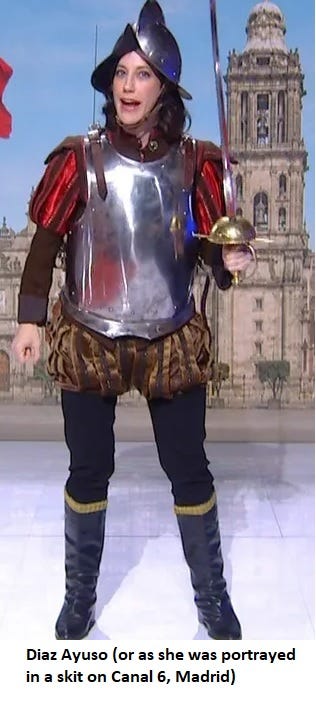
She’s used her platform as President of the Madrid Commune (basically a state governor or provincial premier) to award medals to various Latin American rightists (Juan Guaido — whose name I had to look up, being that unmemorable, and Maria Corina Machado among them) and jetting around … on the public dime … or making video speeches to groups like the Trump Administrations “Shield of the Americas” corral of tame rightist American regimes and assorted European “libertarian” gatherings.
Her fixation on Cortés — while in line with reactionary Spanish thinking — and on the “evils” of the 4th Transformation in Mexico (with an “X”) which she claims (without any proof) is a “narcostate” and “two steps from Venezuela” (apparently having a legislative majority that leans left, and a non-partisan elective judiciary) financed (again with public funds) that extravaganza “opera” (musical theater? over-the-top song and dance routine) produced by her friend Nacho Cano that presents the Cortés-Malanalli saga as a romantic love story… kind of “Birth of the Nation” in where the rapists are the good guys.
With the excuse that an international fair in Aguascalientes would honor Spain this year (thanks to a “generous donation” from the Madrid Commune!) she hied herself, Nacho, his cast of many, and a statue of Hernan Cortés to Mexico… where — outside of the usual suspects (and not even all of them) her lecturing/hectoring the Mexicans about their unconscionable neglect of Cortés’… and his lack of a “proper” tomb.
As it was, Cortés remains have traveled around more than even that reigning champion of post-mortum tourists, Eva Peron. There are at least 9 recorded burial sites, including the several years his bones sat in a filing cabinet in the Spanish Embassy (in the late 1820s, there were anti-Spaniard riots in the city, and the conservative writer Lucas Aleman… at the time the administrator of Hospital Jesus, where Cortés had ended up per his will — dug him up for “safekeeping” and shipped the box to the Spanish Embassy, which was closed for a few years, and then forgotten for about a century, when he was re-interred in 1940s the wall of the Church next to the Hospital, with a modest plaque with this name and dates. At least Diaz Ayusco was able to foist off her Cortés stature (in the side yard of the Hospital).. the only monument to the guy in the country. And, by most accounts, more than he deserves.
Add to that the fiasco of that Nacho Cano production. With great fanfare it was announced it would be part of a “celebration”, including a Mass, at the Metropolitan Cathedral. Uh… no. The Cardinal might allow her to buy a Mass card … and, while the Church is known for some spectacular and entertaining ceremonies, it isn’t licensed as an entertainment venue. It was moved at the last minute (and much expense to the Madrid treasury) to uncertain review. And forgotten.
Diaz Ayuso, wasn’t done, however. Besides her continued attempts to paint the Presidenta as some kind of Stalinist tyrant … who, instead of asking how many divisions the Commune of Madrid had, responded, “Who is she, again?” and… while waiting to be presented with a medal (she paid for) by the grateful citizens of Aguascalientes (or the Chamber of Commerce of that conservative stronghold, anyway), she’s taken off for a “deserved” vacation on the Mayan Riviera.
As to dem bones?
"Well, if [Isabel Díaz Ayuso] loves Cortés so much, I propose we put the guy's bones in a box of Roma detergent and give them to her so she can make bone marrow broth or put them in his bed and sleep with them." (Pedro Miguel, writer and historian)
Sources:
El Universal (04 Mayo 2026) Militante de la 4T solicita al INAH exhumar y empacar a España, los restos del señor Hernán Cortés de Monroy y Pizarro Altamirano
El Debate (Madrid) 18 Marzo 2026: “El homenaje a Hernán Cortés en México que Nacho Cano ha impulsado con éxito contra todas las leyendas negras”
Diario Red (5 Mayo 2026) “Quienes buscan reivindicar a Hernán Cortés y sus atrocidades están destinados a la derrota: Sheinbaum”
Proceso (7 Mayo 2026): “Ayuso: México está “a dos pasos” de ir por el camino de Venezuela”
Alan Barossa: “SHEINBAUM ROMPE A AYUSO CON UNA SOLA PREGUNTA. NINGUNEO EXTREMO” (youtube video)
My own Gods, Gachupines and Gringos (and their sources), a couple studies of the Conquest, various academic “stuff”, including some Cristero memoirs picked up along the way.
… which we usually date from the Diet of Worms, which was happening just as Cortés was marching into Tenochtitlan. As it was, Cortés letters to the King (aka Holy Roman Emperor Charles V) were delivered after the fact, Charles been up the Rhine listening to Luther’s arguments and the counter-arguments.